- Load the data from the CSV dataset into the data vectors r (Rating) and p (Price).
> setwd("c:/workspace") > getwd( ) [1] "c:/workspace" > data_frame <- read.csv("laundry-detergent.txt") > r <- data_frame$Rating > p <- data_frame$Price > r [1] 61 55 50 46 35 32 59 52 48 46 34 29 56 51 [15] 4 8 45 33 26 55 50 48 36 32 26 > p [1] 17 30 9 13 8 5 22 23 16 13 12 14 22 11 [15] 15 17 7 11 16 15 18 8 6 13 - Find the linear regression line for predicting Price from Rating.
> model <- lm(p ~ r)
> model

Call:
lm(formula = p ~ r)

Coefficients:
(Intercept) r
-2.1443 0.3727
The regression equation for predicting r from p is:
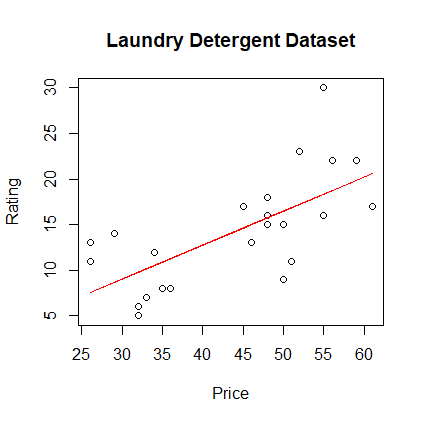
p = 0.3727 * r - 2.1443 - Create a scatterplot of Price vs. Rating. Add the regression line to this plot:
> plot(r, p, xlab="Price", ylab="Rating",
+ main="Laundry Detergent Dataset")
> pred <- predict(model)
> lines(r, pred, col="red")
- Compute r and R2.
> # Correlation between p and r
> cor(p, r)
[1] 0.6707535
> # R-squared value
> cor(p, r)^2
[1] 0.4499103
- Create a residual plot (plot residuals vs. predicted values). Add the
horizontal zero line.
> pred <- predict(model)
> lines(r, pred, col="red")
> res <- resid(model)
> plot(pred, res, xlab="Predicted Values", ylab="Residuals",
+ main="Laundry Detergent Residual Plot")
> lines(pred, rep(0, length(pred)), col="red")
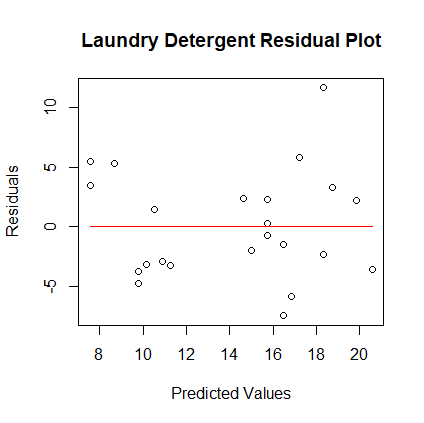
- Interpret the residual plot.
- Create a normal plot of the residuals with the normal line.
> qqnorm(res, main="Normal Plot of Residuals")
> qqline(res, col="red")
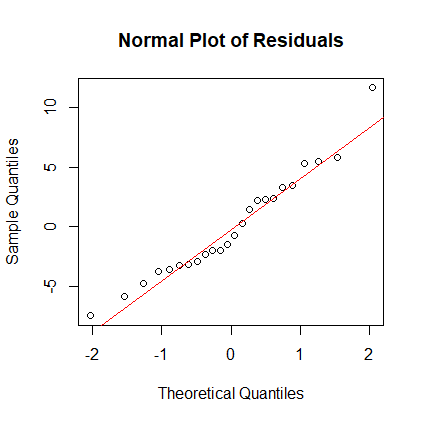
- Interpret the normal plot.
- Compute the height in meters and the weight in kilos of the Bears players.
The conversion rates are 0.3048 meters per foot and 0.4536 kilos per pound.
> setwd("c:/workspace")
> getwd( )
[1] "c:/workspace"
> bearsDf <- read.csv("bears-2024-roster.txt")
> h <- (bearsDf$HtFt + bearsDf$HtIn / 12) * 0.3048
> h
 [1] 1.8796 1.9050 1.8542 1.9304 1.8542 1.8288 1.9558
 [8] 1.8542 1.8034 1.9304 1.9050 1.9304 1.8288 1.8288
[15] 1.9304 1.9050 1.9812 1.9050 1.9558 1.8796 1.9304
[22] 1.8288 1.9050 1.9304 1.8034 1.8796 1.7526 1.8034
[29] 1.7780 1.9558 1.9812 1.8288 1.8288 1.8542 1.9558
[36] 1.8034 1.8288 1.9304 1.9812 1.8796 1.8288 1.8796
[43] 1.8288 1.8542 1.9304 1.8288 1.8034 1.8288 1.9304
[50] 2.0066 1.9558 1.8796 1.8796 1.7272 1.9050 1.7780
[57] 1.8542 1.9050 1.8288 1.8288 1.8034 1.9812 1.7272
[64] 1.8796 1.9304 1.7526 1.9558
> w <- bearsDf$WtLb * 0.4536
> w
 [1]  95.7096  96.6168 101.6064 136.9872 141.0696 105.6888
 [7] 151.0488  90.7200  96.1632 108.8640 141.0696 139.7088
[13]  92.9880  90.7200 132.4512 136.0800 143.3376 143.3376
[19] 141.5232 134.2656 113.4000 109.7712 111.1320  99.3384
[25]  90.7200 108.8640  96.1632  90.7200  91.6272 145.6056
[31] 100.6992  88.9056  94.3488 102.0600 140.6160  86.1840
[37]  90.7200 121.5648 117.9360 136.0800 102.0600 109.7712
[43]  95.2560  90.7200 139.2552 104.7816  95.2560  88.4520
[49] 136.0800 150.5952 114.7608  91.6272 106.1424  79.3800
[55] 102.5136  83.9160 114.7608 129.2760  93.8952  92.5344
[61]  81.6480 118.8432  97.5240  95.2560 127.0080  81.6480
[67] 151.0488
Find the simple linear regression equation for predicting weight in kilos from height in meters.
> model <- lm(w ~ h)
> model

Call:
lm(formula = w ~ h)

Coefficients:
(Intercept) h
-331.5 236.0
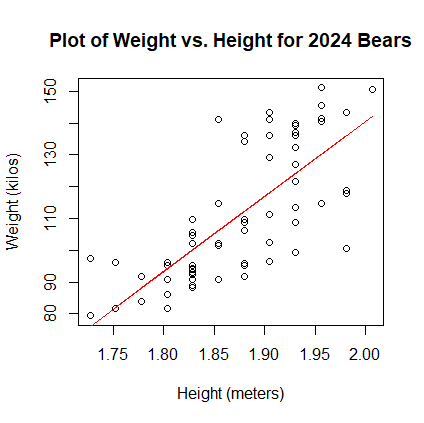
The linear regression line for predicting weight from height is
w = 236.0 * h - 331.5 - Use R to create a scatter plot of weight (y-axis) vs. height (x-axis). Add the regression line to the plot.
plot(h, w, xlab="Height (meters)", ylab="Weight (kilos)",
+ main="Plot of Weight vs. Height for 2024 Bears")
> pred <- predict(model)
> lines(h, pred, col="red")
- Create the residual plot, which is the residuals (y-axis) vs. the predicted values (x-axis).
> res <- resid(model)
> plot(h, res, xlab="Height (meters)", ylab="Residuals",
+ main="Residual Plot 2024 Bears")
> lines(h, rep(0, length(h)), col="red")
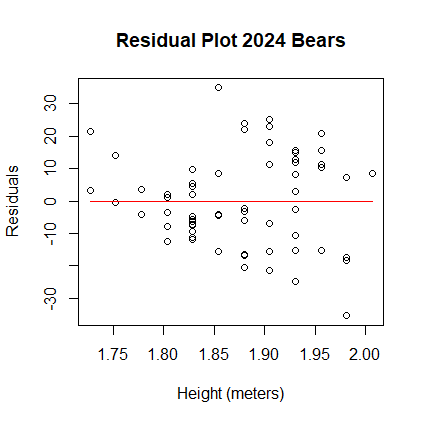
- Interpret the residual plot.
Answer: the residuals are slightly biased and heteroscedastic. - Create the normal plot of the residuals. Add the normal line to the plot.
> qqnorm(res, main="Normal Plot of Residuals 2024 Bears")
> qqline(res, col="red")
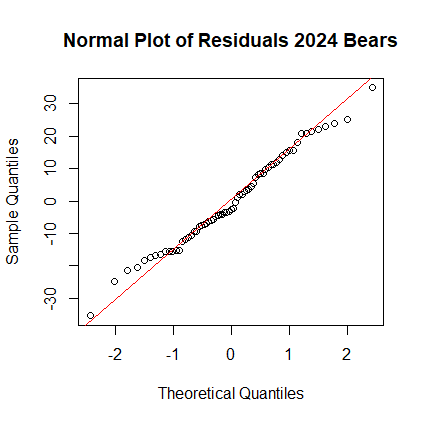
- Interpret the normal plot.
Answer: the normal plot shows small random variations above and below the normal line. This means that the residuals are approximately normally distributed.