The Mexican educational system consists of three levels:
primary, secondary, and higher education. Formal basic education encompasses
preschool, elementary, and lower secondary. Basic education accounts for
approximately 81 percent of the total number of students receiving school
services. Federal, state, and local governments provide 93 percent of basic
education, while private schools provide about 7 percent. In 2000 there were
29,700,000 students enrolled in all levels of education. Of these, 23,612,000
were enrolled in basic education grades. According to estimates from the
Secretaría de Educación Pública or SEP (Public Education Secretariat), school
enrollment for children aged 6 to 14 years stands at about 92.08 percent.
However, only 46.68 percent of those between the ages of 15 to 19 years attend
school.
Higher education consists of three types: universities, technological colleges,
and teacher-training institutes. There are private and public institutions of
all three types, but public institutions are more numerous and usually larger,
with over 80 percent of students attending public universities and colleges.
Each state has at least one public university, often having campuses in
different cities. The largest public university, the National Autonomous
University of Mexico in Mexico City, has more than 100,000 students. ‘Over
ninety technological institutes had about 17 percent of the total higher
education population in 1994. Teacher-training institutes are separate from
general universities and generally offer a four-year curriculum. Universities in
fourteen states offer postgraduate courses, and in 1991 over 28,000 students
were enrolled in master's degree programs and 1,250 in doctoral studies. Most
students pursuing graduate work, however, do so outside Mexico.’ 3.1
Access to Information and Communication Technologies in
School: (Stage 2-3)
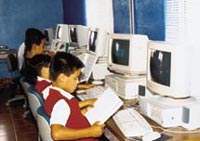 |
Over the past few years
there has been a growing trend toward modernizing the educational systems in
Mexico.
The new
technologies in the education sector will enable Mexico to improve its
competitiveness in the global market. ‘Although Mexican schools have budget
challenges, the Government has already invested in technology to enhance the
quality of education, and as of today, 4.9% of public elementary schools and
13% of middle schools are already using computers and internet services.’
3.2
According to
http://www.aps.edu/aps/mckinley/library.html students in Mexico use the
computers during school hours for research and project preparation. Before
school, computers are to be used only for homework. During lunch, computers
can be used for homework and approved games. After school, student use computer
access for do their homework and playing games. Computers are primary
provided to classrooms in college and university level with an internet
access as well as to their own national school network. |
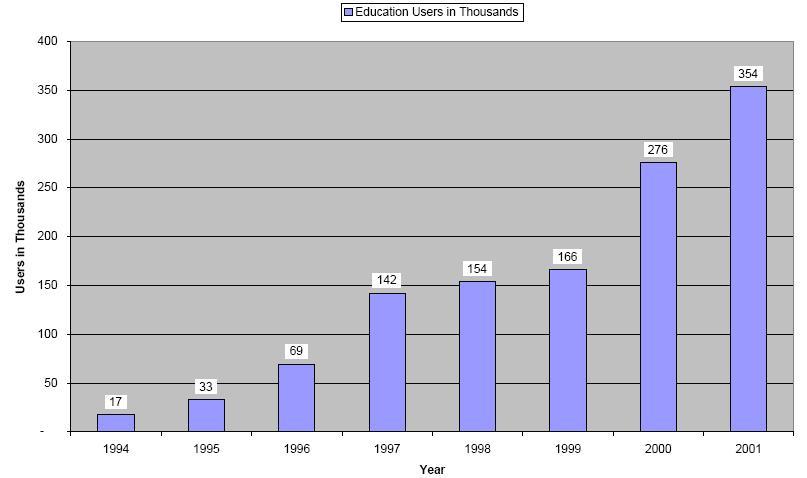
Education Internet Users in Mexico
Source:
http://www1.lanic.utexas.edu/project/etext/mexico/thomasson/thomasson.pdf
Before 1995, education drove growth. This segment had the
largest number of users until 1995. Internet availability and use at this time
was centered in Mexico’s university system. Mexico’s universities developed
extensive regional networks. Universities were highly instrumental in the
development of Mexico’s first national backbone, which connected their regional
networks. ‘Although
academia was one of the drivers of the development of the Internet in Mexico and
Internet use is well-entrenched in Mexico’s university system, the GDI criterion
for academia also includes Internet usage in secondary education. The use of the
Internet is not nearly as extensive in secondary schools as it is in
universities in Mexico.’ 3.3
There are telecommunications
and digital divides in Mexico. Large segments of the populace have little or no
access to both computers and the Internet. Many schools and universities have
inadequate information technology resources. In 2001, Mexico joined a consortium
of American universities to link to Internet–2, a set of advanced networking
technologies that enable distant collaboration on complex projects. Internet–2
technologies are also being used to link far–flung educational institutions
through video conferencing. There are 61 member institutions in Mexico’s
Internet–2 consortium including universities, some governmental and medical
institutions, and five information technology companies Internet–2 also enables
Mexican institutions to access supercomputers and other advanced resources in
the United States and other countries.
Enhancing Education with Information and Communication Technologies: (Stage 3)
Distance
learning in Mexico is an emerging sector in the Mexican market and can offer
good growth opportunities to U.S. universities, educational institutions,
training providers and other content developers. With over 20 million Internet
users in Mexico, e-learning has become a good option to provide lower cost or
remote programs in the education and training sectors. Education has been a top
priority for the Mexican government in the last 6 years. The government has
invested not only in infrastructure, but also in creating more resources to
train more people in order to compete in the global market.
U.S.
institutions and e-learning training companies have a good potential in Mexico
by partnering with Mexican higher education institutions and training companies
to offer and develop e-learning programs.
Computer technology and
telecommunications could become the cornerstone to distance education in Mexico,
as well as all parts of the world. Telecommunications infrastructure allows
potential students to communicate via several modes: tele-conference, Internet,
fax, and many others. Currently, Mexico has 12 telephone sets for every 100
inhabitants and a modern digital telecommunications infrastructure that includes
1,000 miles of optical fiber and numerous international links. Mexico also has
satellites with continental coverage and a computer system that includes 4.2
million installed computers, 600,000 of which have Internet access. Although the
number of Internet users in Mexico is growing, it is limited by the number of
personal computers, according to Ortiz. ‘It is estimated by 2002 that
educational institutions will have more than one million Internet access
accounts in Mexico. Almost all primary and secondary subjects are taught via
advanced technology; as well as online textbooks and reference materials through
ILCE.’ 3.4
Teachers in high education
level like college or university deliver their courses materials through the
Internet. Students in can sign up for courses not offered by their home school.
Many teachers set up web pages where supplemental material or links to
information for their courses.
Developing the
Information and Communication Technologies Workforce: (Stage 3)
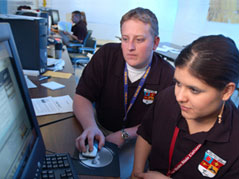 |
Mexico offers a wide range of schooling and training in Information and
Communication Technologies. The training is available in both distance
learning and in class.
Mexico has many opportunities for continuing education and training in ICT
for its existing workforce. People in Mexico have access to specialized ICT
training that can be pursued at either the university or college level.
|
|
|
|