Networked Economy
Japan was a late entrant to the e-commerce market, however, it has created a number of significant policies to facilitate on line business.
"We will strive to establish an environment where the private sector, based on market forces, can exert its full potential and make Japan the world's most advanced IT nation within five years."5.1
The "e-Japan" strategies include the "e-Japan Priority Policy Program"5.2 and the "e-Japan 2002 Program."5.3
Priority policy areas include the following; "establishment of the ultra high-speed network infrastructure and competition policies, facilitation of electronic commerce, realization of electronic government, nurturing high-quality human resources."5.4
The Ministry of Economy, Trade and Industry (METI) subsequently prepared "Interpretative Guidelines on Electronic Commerce" in March 2002.
The purpose of the guideline was to illustrate how e-commerce legal issues would be handled (through a form of arbitration).
On-line contracts, consumer protection, license agreements, and intellectual property were some of the subjects addressed.5.5
ICT Employment Opportunities (Stage 3)
"Japan's unemployment rate hit a record high of 5.4% in 2002, up 0.4 percentage point from the previous year and breaking the record for the second straight year...'Japan is likely to see another tough year for employment.'"5.6
As of January 2003 the number of people employed in Japan totaled approximately 63 million, a decrease of 1% from the prior year.5.7
The total "technical/professionals" employed as of December 2002 was 2,370,000, and "business service which includes information services and investigations" was 560,000.5.8
Five year projects show overall employment slowly decreasing at a rate of .5% per year.5.9
However, significant growth is expected in the area of information technology.
According to the Japanese Institute of Labor, "The number of workers in professional, technical and related support occupations is projected to grow by one million, an increase of 10 percent.
Much of this growth is due to the expected increase in demand for engineering, computer and health-related occupations.
This group of professional occupations is expected to continue to grow faster than the employment rate overall, and to increase its share of total employment from 14.0 percent in 2000 to 15.6 percent in 2010."5.10
Technical skills are becoming more important, however Japan faces increasing foreign competition (outsourcing, influx of foreigners).
Education plays an important role in an individuals employment prospects.
ICT jobs tend to be concentrated around major cities.
Japan is at Stage 3 because it is attracting individuals from other countries.
Business-to-Consumer (B2C) Electronic Commerce (Stage 3)
The "E-readiness" of Japan was assessed by the Economist Intelligent Unit.
As of July 18, 2002, Japan was ranked 25 of 60, and earned a readiness score of 6.86 of 10.
The readiness score decreased from May 2002, when it was assessed as 7.7.5.11
This decline may be attributable to the initially slow rate of Internet adoption.
"With the introduction of the so-called third-generation or 3G phones in 2001, which allow the transmission of larger amounts of data more rapidly, Internet use in Japan is set to rise further in coming years."5.12
"Japan's mobile-phone subscriber base grew 12% year-on-year, to 74.8m in March 2000..."5.13
"Another important trend in Japanese e-commerce is the emergence of online banking and investment markets.
There were already four Internet-based banks in operation in June 2002."5.14
In 2001 B2C e-commerce increased 80% from the previous year.5.15
Online shopping communities are also growing, such as Venture Republic, which specializes in electronics.5.16
Many websites include information about goods and services for sale.
However, B2C e-commerce transactions are not purely online; purchases can take place in person, by phone or email.
Travel and computer hardware/electronics industries used the world wide web for marketing.
Therefore, Japan's B2C e-commerce practices are at Stage 3, and will move to Stage 4 when more consumers have adapted to online trade.
Business-to-Business (B2B) Electronic Commerce (Stage 3)
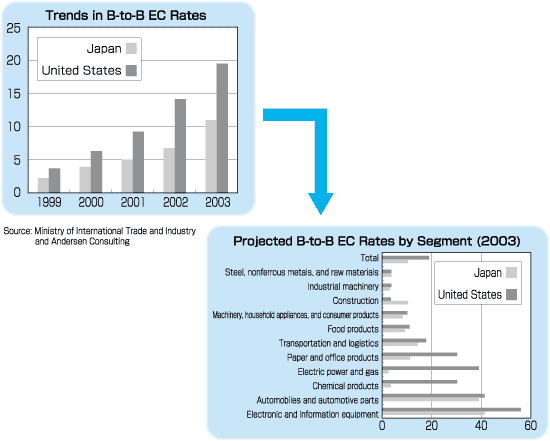
B2B commerce in Japan increased 60% from 2001 to 2002, and approximately 10% of the B2B market is based on online shopping communities.5.17
Trading associations are helping market e-communities in various industries such as travel, paper, construction, and oil as illustrated in B2B case studies written by JETRO.5.18
New business models are being developed for e-commerce.
EC-Oil adopted a variation of the e-commerce business model.
"EC-Oil provides a bid-based, trusted-third-party system where buyers and sellers can negotiate bulk oil purchases in complete anonymity -- important for establishing true market-made prices."5.19
Trend data indicates that the electronic and information equipment, and automobiles and automobiles parts industries in particular, will experience the most significant growth.5.20,5.21
Levels of B2B e-commerce transactions are growing very slowly and transactions are not purely online.
The deployment of electronic systems has increased efficiency and transparency.
Japan is at Stage 3 and will move to Stage 4 when more trading partners enter the e-commerce channel.
E-Government (Stage 3)
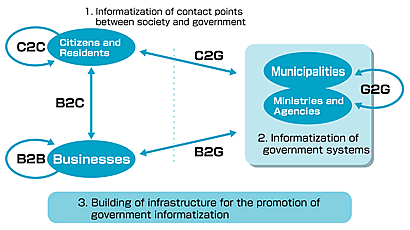
Japan has implemented policies to improve the government procurement process, including the "e-Japan Priority Program - 2002."
It requires use of the web to digitize the government's own operations.
Microsoft Corp. Chairman Bill Gates recently visited Japan to promote Microsoft's software systems for "Tokyo's 'e-Japan' project aimed at employing more information technology (IT) in delivering government services."5.22
The Electronic Commerce Council of Japan (ECOM) has played a crucial role in developing guidelines to help implement e-Japan goals.
ECOM created the e-Government Subcommittee to monitor progress of e-government initiatives and make recommendations to more sharply focus e-government activities including government outsourcing, government portals, and electronic government benchmarking.5.23
The JETRO web site is one of the most complete sites for providing information for business start-ups in Japan (government-to-business online commerce).
As an example of e-government at the local level, Tokyo has a web site that includes news and information content, as well as on line resources for local activities.
The City of Osaka's website is informational.5.24
It mainly describes the city and its history, "sister-cities," major city events, and projects.5.25
The majority of governmental websites are at the "federal" level, where most if not all of the Ministries have websites.
The government does provide resources for B2B partner matching, however, the sites are not interactive.
Information is not kept current and relevant.
Most of the Internet and e-commerce information and statistics were dated 1999-2001.
Local governments are slow to adopt e-commerce initiatives.
Japan is at Stage 3 e-Government.