Total Telecommunications
Services Revenues: $3.7 billion dollars (USD)[1]
The breakdown of this investment into market sectors is as follows:
Fixed Services - 40%
Cellular Telephony – 38%
Cable TV – 11%
International Long Distance – 7%
Terminal Equipment and Business Systems – 2%
Internet Services – 2%
Telephone
Israel has 2.8 millions main telephone lines which is equivalent to a 47% penetration rate
Israel is one of only a few countries to have a 100% digital telecommunications network
Israel’s digital network is deployed throughout the country and includes ISDN lines and Fiber Optic cabling
Domestic and Long Distance Service
In January 2001, Bezeq
Communication’s (Israeli National Telecom), authorized monopoly of the
national telephone infrastructure ended when ‘Ofek the New World Ltd’ was
granted a general fixed services license by the Ministry of Communications to
start operations for domestic telephone service.
Prior to this, Bezeq had annual sales of approximately NIS (New Israeli
Sheqel) 9.3 billion, and retained 11,500 employees.
Bezeq is responsible for the 100% digitalization of the telecom network.
In November 1995, the Government of Israel published a tender for two additional telecommunication licenses for international service to compete with Bezeq. There were two groups awarded these licenses. The first license was issued to Golden Lines, owned by Southwestern Bell Corporation, Italy’s STET, Aureq, Globescom, and Meitar/Kahan. The second license was issued to Barak, owned by Sprint, Deutsche Telekom, France Telecom, Klalcom, and Matab.
International Service Providers pay 5% royalties on all their income
They may operate and invest jointly in submarine cabling systems
The three providers offer consumer, business, and carrier service offerings
There are three services delivered on the all-digital network. They are:
Switching facilities that incorporate an advanced intelligent network infrastructure
Optical
submarine cables, digital satellite links, and modern operations facilities
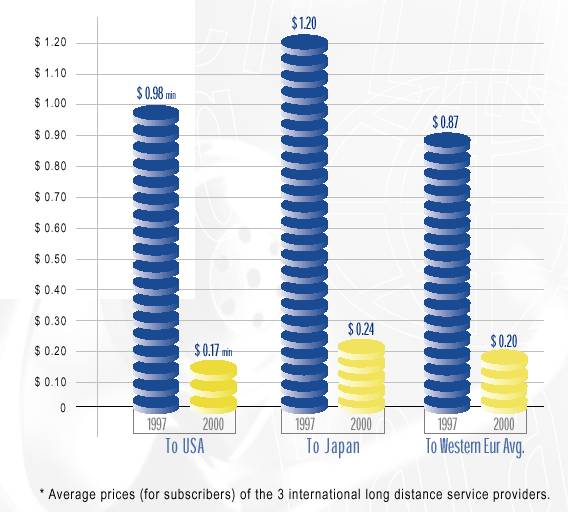
The major beneficiaries of these new services are the Israeli people. The chart below shows the decrease in consumer prices as a result of these actions[2]
Number of Public Pay Phone: 41,407
Number of Telephone Lines in Operation: 2,819,000
Cost of Residential Telephone Service (USD): $140.00/month
Cost of Residential Telephone Service (USD): $8.00/month
Cost of Business Telephone Service (USD): $140.00/month
Cost of Business Monthly Telephone Subscription (USD): $8.00/month[3]
Cellular
In the cellular market there are three major service providers. They are:
Pelephone, owned by Bezeq Communications and Motorola Israe
Cellcom, owned by BellSouth and Safra Banking Family and Discount Investment Ltd.
GSM
Digital Technology owned by Hutchison of Hong Kong and Israeli Investors
Each company deploys different
technologies to service its customers. Pelephone
uses NAMPS and CDMA Technology. Cellcom
uses TDMA technology. GSM Digital
Technology operates according to the GSM standard.
Each of the three cellular providers offers country-wide coverage.
Text and data services are now available in SMS, WAP and IP formats, and
GPRS and EDGE technologies are on the threshold of being placed into use.
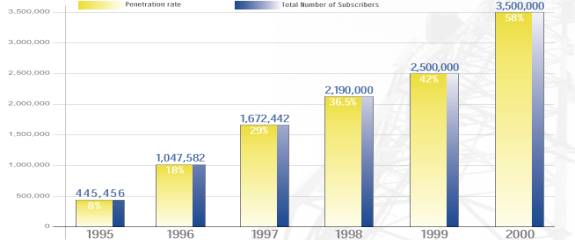
Today there are 3.5 million
cellular telephone customers, a penetration rate of 58%, up from 0.1 million in
1995. This explosive growth was
achieved by providing nationwide coverage, low tariffs, use of the Calling Party
Pays (CPP) method, network quality and an effective marketing strategy.[4]
Analyst’s predictions
indicate a significant slowdown in the cellular arena in 2001.
Pelephone is expected to persist with its share of the cellular market in
2001. Cellcom will face a shortage
of frequencies in 2001 that could affect its growth rate.
Cellcom may be forced to adopt new technology, CDMA or GSM, to solve this
problem. No predictions were made
about GSM Digital Technology.
The following diagram shows the growth of the cellular industry over the last six years.
Commercial Broadcasting
Israel has 1.15 million
cable-connected households, a penetration rate of 72%.
Cable TV coverage extends to 95% of the households in the country.[5]
There are three multi-channel
cable television operators, each with a geographic monopoly, as well as a Direct
Broadcasting Satellite operator that uses Israel’s AMOS-1 satellite.
Israel has two national television channels, one public and one commercial. A second commercial channel is expected to start operating in 2001. Additionally, there are five special interest channels.
Television |
Total
Number |
Number per 100 inhabitants |
|
Number of TV sets |
2.6 million |
41.8 |
|
Number of Home Cable TV Subscribers |
1.15 million |
18.2 |
|
Number of homes equipped with satellite |
150,000 |
3.8 |
Internet
Israel has an estimated one
million users, 30,000 domains, 800,000 dial-up and 5,000 direct-connect
customers. Approximately, 305 of
Israeli households, and 60% of Israeli businesses use the Internet.
There are four major and thirty smaller Internet Service Providers
(ISP’s) that service Israel’s Internet users.
An annual growth rate of 50% is expected over each of the next five
years.[7]
Factors encouraging this type of growth include:
Widespread use of computers in businesses and households
An advanced local telecommunications infrastructure
Low tariffs and
A regulatory policy of minimal intervention
Other factors encouraging Internet usage are:
The availability of sophisticated Hebrew language portals
Israel’s recognition as a leader in the development of Internet applications and products
Israeli companies years of marked success in the Internet arena
This international reputation is recognized on the home market and contributes to local interest and use of the Internet.
Main Internet Service
Providers
|
Company |
Web
Site |
Number
of Subscribers |
|
Netvision |
300,000 |
|
|
Internet Zahav |
200,000 |
|
|
Bezeq Beinleumi (International) |
Not given |
|
|
Barak ITC |
Not given |
|
|
Actcom |
Not given |
|
|
Matav Internet |
Not given |
Main Internet Portals
Name |
Web
Site |
|
Walla |
|
|
Nana |
|
|
MSN |
|
|
Ynet |
|
|
IOL Israel Online |
|
|
Tapuz |
|
|
Maariv |
|
|
Start |
|
|
Haaretz |
|
|
Netking |
|
|
Yellow Pages |
|
|
Globes |
|
|
The Marker |
http://themarker.com |
The following chart, developed in 1997, was taken from the below listed source and summarizes some of Israel’s ISP’s and their offerings.
|
Provider |
International
Capacity (M/Bit)1 |
Optical
/ Satellite2 |
Direct
European Connectivity3 |
IIX
Connection4 |
Infrastructure
Quality |
"Israeli
Internet" Rank (Smallest best) |
|
|
Multiple International
Lines (Backup) |
Has a Single Point of
Failure5 |
||||||
|
0.75 |
Satellite |
No |
Yes |
No |
Yes |
6 |
|
|
1.5 |
Satellite |
No |
Yes |
No |
Yes |
8 |
|
|
4.75 |
Mixed Satellite/
Optical |
Yes |
Yes |
Yes |
Yes |
2 |
|
|
1.5 (via IBM) |
Mixed Satellite/
Optical |
No |
Yes |
Yes |
Yes |
Non Applicable |
|
|
?? |
Satellite |
No |
No |
No |
Yes |
9 |
|
|
5.65 |
Satellite |
No |
Yes |
Yes |
No* |
3 |
|
|
0.9 |
Satellite |
No |
Yes |
Yes |
Yes |
4 |
|
|
9.5 |
Optical |
No |
Yes |
Yes |
No* |
1 |
|
|
0.5 |
Satellite |
No |
Yes |
No |
Yes |
7 |
|
|
1.5 |
Optical |
No |
Yes |
No |
Yes |
5 |
|
Click on the above ISP’s links to see a map of their networks!!![10]
Number of Internet users as of December 2000: 1,270,000
Number of Domestic Internet users as of December 2000: 1,130,000
Number of Internet users per 100 inhabitants: 17.41 (12/2000)
Estimated Internet penetration in businesses: 77,000 or 60% (12/2000)
Number of Telecommuting workers as of 1998: 15,000[11]
In addition to fiber optic and digital networks, Israel makes use of modern X.25, Frame Relay, ATM, IP, and Switched networks to service its Internet users.
[1] Source: Israel Ministry of Communications http://www.moc.gov.il/new/english/index.html
[2]
Source: Ibid. Telecommunications
in Israel 2001 http://www.moc.gov.il/new/documents/telecom_in_israel_11.00.pdf
[3] Source: ITU World Economic Indicators ’98 http://www.itu.int/
[4] Source: Israel Ministry of Communications http://www.moc.gov.il/moc/doa_iis.dll/Serve/item/English/1.2.4.6.html
[6] Source: European Information Society for Israel http://esis.org.il/ILBasicq7updated.doc
[7] Source: Israel Ministry of Communications http://www.moc.gov.il/new/documents/telecom_in_israel_11.00.pdf
[8] Source: European Information Society for Israel http://esis.org.il/ILBasicq7updated.doc
[9] Ibid
[10] Source: Israel Internet Guide http://www.iguide.co.il/isp-sum.htm
[11] Source: European Information Society for Israel http://esis.org.il/ILBasicQ7updated.doc


