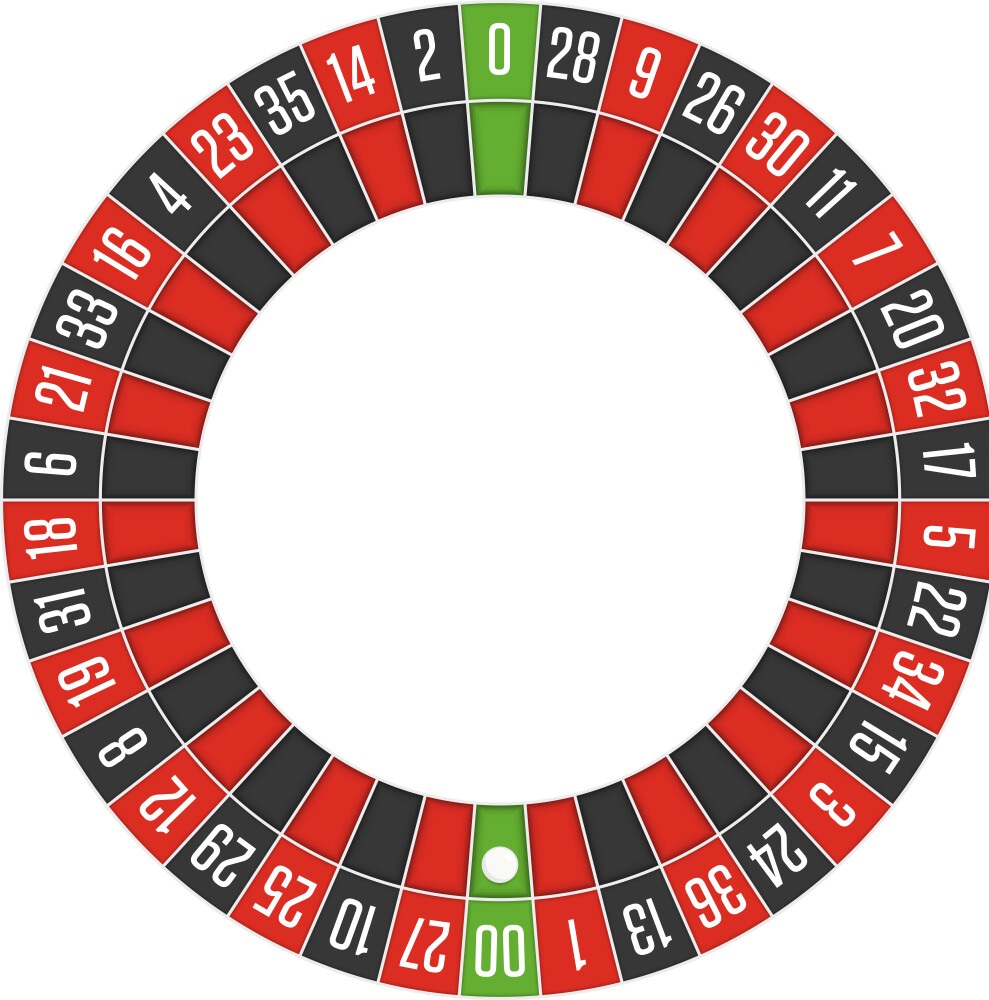
If you bet on red or black, here are the payoff tables for an American roulette wheel, for a bet of $100:
| Bet on Red | ||
|---|---|---|
| Outcome | Payoff | Probability |
| Red | +100 | 18/38 = 0.474 |
| Black | -100 | 18/38 = 0.474 |
| Green | -100 | 2/38 = 0.052 |
| Bet on Black | ||
|---|---|---|
| Outcome | Payoff | Probability |
| Red | -100 | 18/38 = 0.474 |
| Black | +100 | 18/38 = 0.474 |
| Green | -100 | 2/38 = 0.052 |
What is the expected payoff of playing on red? playing on black?
Answer: Playing on red is
E(x) = 100(0.474) + (-100)(0.474) + (-100)(0.052) = -5.26.
You expect to lose about $5.26 each time you play on red with a $100 bet; same for black.
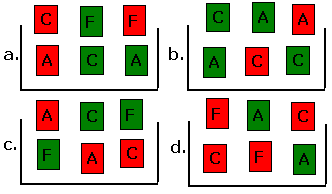
Answer: In a and b, letter is independent of number. To show that letter and number are independent, you need to show that for each letter value L, P(L)= P(L|C) for a specific color C. For example, in Problem 2a, if you are not restricted to a specific color,
P(A) = P(B) = P(C) = 2/6 = 1/3.
If you know the color is red, P(A|red) = P(B|red) = P(C|red) = 1/3. If you know the color is green, the probabilities are also 1/3.
In Problem 8c, if you don't know the color, P(F) = 2/6 = 1/3. If you know that the color is green, P(F|green) = 2/3 = 2/3, so color and letter are not independent.
To show that two events are not independent, it is enough to find one case where the probabilities are different; to show that two events are independent, you must show that the probabilities are the same for all choices of color and letter.
Answer: E(S) = nE(x)
Answer: Var(S) = nVar(x)
Answer: The Law of Averages says that if the number of observations n is large, the average of n independent outcomes of a random variable x is close to the true expected value E(x) of the random variable.