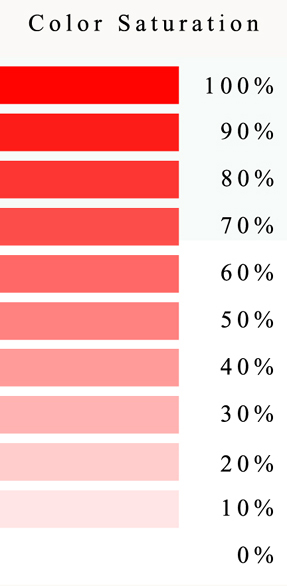
Saturation
Saturation, along with hue and brightness make up the three distinct attributes of color. Pink may be thought of as having the same hue as red but being less saturated. A fully saturated color is one with no mixture of white. A spectral color consisting of only one wavelength is fully saturated, but one can have a fully saturated magenta which is not a spectral color. Quantifying the perception of saturation must take into account the fact that some spectral colors are perceived to be more saturated than others. For example, monochromatic reds and violets are perceived to be more saturated than monochromatic yellows.
There are many different mixtures of wavelengths which can produce the same perceived hue. The achromatic line from black to gray to white through the center of the circle represents light which has no hue.
Note that the blue of the sky is more saturated when you look further from the sun. The almost white scattering near the sun can be attributed to Mie scattering, which is not very wavelength dependent. The mixture of white light with the blue gives a less saturated blue.