


 most similar items to the target item and generate a predicted value for the target item. We use a weighted sum as follows.
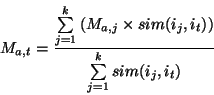
Here,  denotes the prediction value of target user
  on target item
  . Only the most similar items ( nearest neighbors of item ) are used to generate the prediction. Despite their effectiveness, item-based CF algorithms still suffer from the problems associated with data sparsity, and they still lack the ability to provide recommendations or predictions for new or recently added items. To deal with these problems, we introduce an approach for semantically enhanced collaborative filtering in which structured semantic knowledge about items, extracted automatically from the Web, is used in conjunction with user-item ratings (or weights) to create a combined similarity measure for item comparisons. This approach is discussed in the next section.